 ← More at erikpeers.com
I'm Erik Peers, an Executive Coach. I work with senior people coming off prescribed psychotropics while the career is still running. I write reviews of books that have informed the way I work over the years.
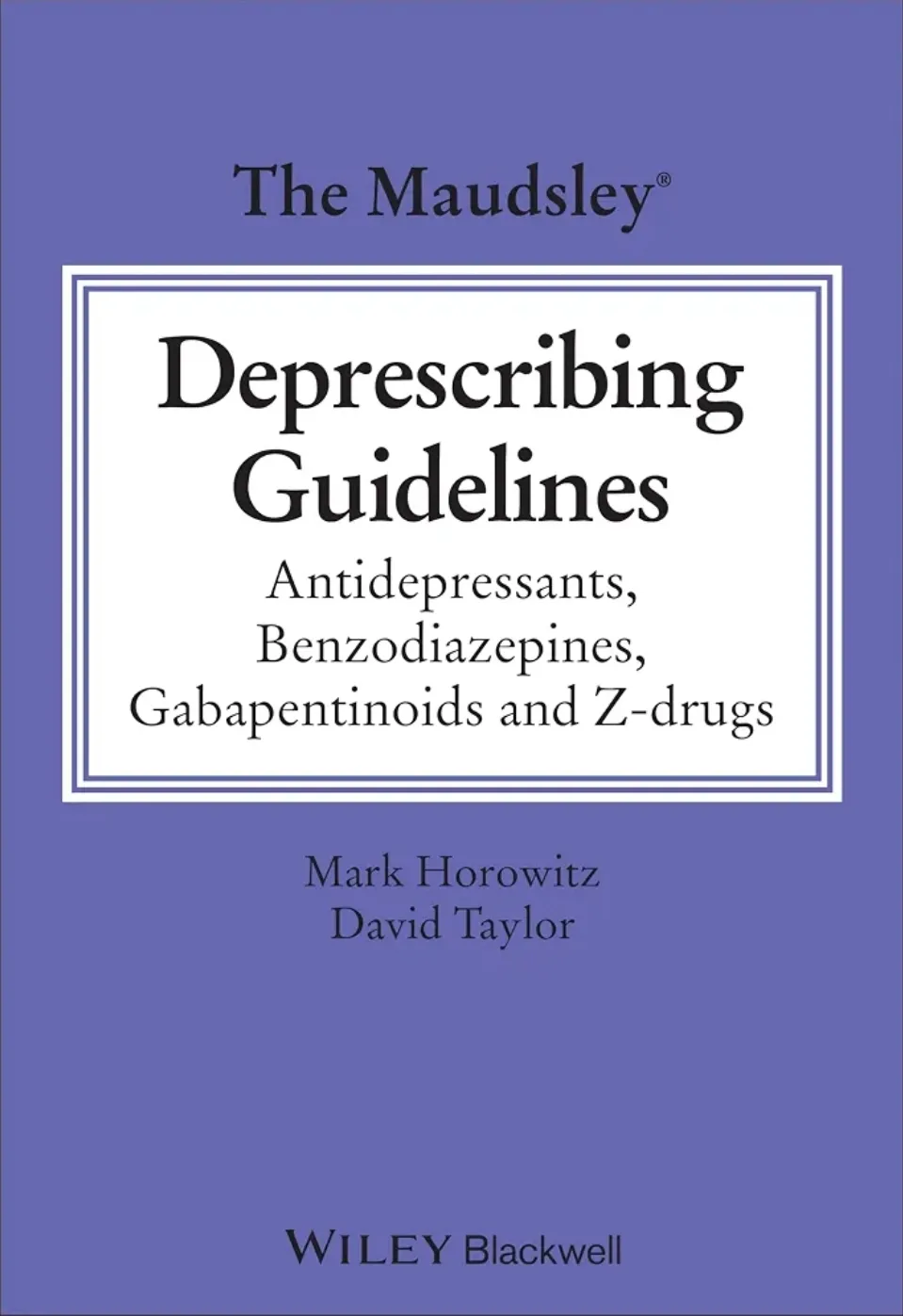
The Maudsley Deprescribing Guidelines: Antidepressants, Benzodiazepines, Gabapentinoids and Z-Drugs
Summary
A 592-page clinical reference for safely reducing or stopping antidepressants, benzodiazepines, gabapentinoids and z-drugs, written by a psychiatrist-in-training and a professor of psychopharmacology. It sets out, for the first time in one place, a proper evidence base for hyperbolic tapering — reducing by a shrinking proportion of the current dose rather than a fixed amount.
"Safely stopping psychiatric medications is not simply a matter of outlining a regimen of reducing doses for patients to follow." — Horowitz and Taylor, 2024
Why It Matters
This is what I point prescribers to when a taper plan needs a published, referenced basis. The gradual, symptom-led reduction it sets out is close to the method I worked out alone, with no name for it, years before I ever read this book — which I take as confirmation the mechanism is real.
Review
For most of psychiatry's history, prescribing has had guidelines and deprescribing has not. The Maudsley Prescribing Guidelines have been the standard reference in psychiatry since 1993, now in their fourteenth edition. Nothing of comparable weight existed for coming off. This book, published in 2024 by Mark Horowitz — a psychiatrist in training who has been through his own severe withdrawal — and David Taylor, Professor of Psychopharmacology at King's College London and long-time editor of the prescribing guidelines, is the first serious attempt to close that gap.
It runs to 592 pages and does not shortcut anything. Medication by medication, it sets out how to reduce and stop antidepressants, benzodiazepines, gabapentinoids and z-drugs, built on the principle the authors first proposed in Horowitz MA, Taylor D. “Tapering of SSRI treatment to mitigate withdrawal symptoms.” Lancet Psychiatry. 2019;6(6):538–546. doi: 10.1016/S2215-0366(19)30032-X — that a drug's effect on the brain does not fall in a straight line as the dose falls, so the dose itself should not be cut in a straight line either. Cut a high dose in half and comparatively little changes. Cut a low dose in half and the effect can be severe. Most tapering schedules, including the one I was first given, ignore this completely.
I did not know any of this when I worked out my own taper. What I had was a psychiatrist telling me that stopping would kill me, and a conviction that staying on the medication was killing me anyway. I reduced by one twenty-eighth at a time, held for two weeks, then reduced again. I had no name for what I was doing and no literature behind me. I had tried unsuccessfully to taper three times before I finally found a way that worked. Reading this book years later, I recognised the shape of my own method in it — because the body seems to arrive at the same answer whether or not anyone has written it down.
Horowitz also writes about colleagues mistaking withdrawal for relapse — a real problem, and one I care about. But the book stays sparse on evidence there; it names the problem more than it solves it. Telling the two apart reliably needs a proper instrument, which is why I helped build a 57-item checklist on the DESS model for exactly that purpose. This book and that checklist do different jobs, and I would not want to overstate what either one covers alone.
What this book is not is something to hand a client on day one and say, “read this.” It assumes a working clinical vocabulary, and it is not written to be reassuring — it is written to be correct. I use it the way I would use a specialist reference: to prepare for a conversation with a prescriber, to check a proposed schedule against, and occasionally to settle an argument. For that purpose, there is nothing else close to it.
Crucially, the book clarifies the profound difference between physical dependence and substance abuse disorders aka addiction. It helps to remove the unfair stigma often carried by individuals struggling to step down their doses. It equips practitioners with the knowledge to reliably distinguish standard withdrawal manifestations (such as insomnia, physical distress, or intense anxiety spikes) from a genuine return of the underlying psychiatric condition.
For my own practice, this book is the reference behind the Pharmacological pillar. What it actually gives me: the receptor-occupancy argument for hyperbolic tapering, and the clearest debunking I know of the old standard — cut the dose in half, wait two weeks, see what happens. It does not solve withdrawal versus relapse on its own. That is a narrower, harder problem, and closer to what the checklist above is for.
The Verdict
A clinical reference, and it reads like one — dense, technical, written for prescribers rather than for someone in the middle of a taper. Worth having if you want the primary source behind your own plan, or something with real authority to bring to an appointment. If you want something written directly to you, I can help with that separately; this is a document to consult with your prescriber, not one to read cover to cover alone.